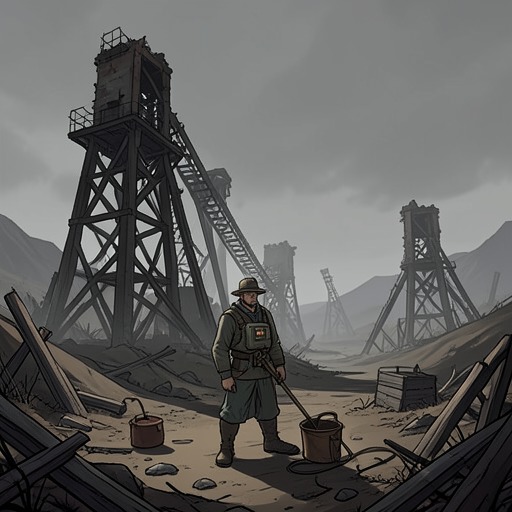
Tevershall pit-bank
Lady Chatterley's LoverTevershall pit-bank is the burning waste heap of the local colliery, an industrial presence whose smoke, smell, and soot reach into the grounds of Wragby Hall. It is both a physical feature of the landscape and a recurring measure of how mining penetrates domestic and rural spaces: its waste can be made into a garden path, but the fumes and black deposits cannot be kept outside. Around it, the novel connects the coal economy to environmental damage, industrial power, and the decline of older ways of life.
Setting and material presence
Tevershall pit-bank is already burning when the Chatterleys return to Wragby in autumn 1920, and it has been burning for years. Extinguishing it would cost thousands, so the fire is left to continue. When the wind blows toward the house, the air fills with the stench of sulphurous combustion; even when it does not, the atmosphere carries the smell of sulphur, iron, coal, or acid. Soot settles persistently, even on the Christmas roses. The heap thus makes the colliery present well beyond its workings: industrial waste enters the air, the garden, and the ordinary experience of the estate.
That presence is rendered through repeated, specific intrusions rather than a single disaster. From Wragby’s dismal rooms, the sounds of the pit include rattling screens, the winding engine, shunting trucks, and colliery locomotives. At night, the furnaces cast red patches across the low clouds. Connie initially experiences the scene with horrified fascination, as though she were living underground, before becoming accustomed to it. Habit does not remove the pollution; it makes an ongoing disturbance part of daily life.
Waste made into a path
The spoil heap’s residue also appears in a more intimate setting. On a frosty walk across the park, Clifford Chatterley and Connie follow a path newly gravelled with sifted material from the pit-bank. After the rock and refuse have burned and released sulphur, the gravel turns bright pink: shrimp-colored in dry weather and darker, crab-colored in wet. In the frost it is pale shrimp-colored beneath a bluish-white coating, and Connie takes pleasure in its color underfoot.
The path brings two consequences of mining into the same image. The material that contributes to the estate’s pollution can be repurposed as an attractive surface within its grounds. Yet this small benefit does not undo the source’s continuing fire, fumes, and soot. The path’s appeal depends on an industrial residue whose larger presence remains damaging, making the boundary between estate landscape and mining landscape materially porous.
The mine and its changing economy
Tevershall pit-bank belongs to a colliery whose fortunes are weakening. Tevershall was once a famous and profitable mine, but its best days have passed; New London, the other local colliery, is also in difficulty. Workers have left for Stacks Gate and Whiteover, where newer works and chemical production offer a different industrial future. The possibility that Tevershall will close is described as a threat to a community accustomed to the mine’s continuous operation.
Mining’s transformation is also a change in labor. The newer workings rely increasingly on machinery, including coal-cutting machines that some workers fear and regard as wasteful. The reported economic logic is that what is lost through waste can be saved in wages. The local industry therefore promises productivity while raising the prospect that machines will displace the people whose work sustained the older pit. Tevershall pit-bank stands beside this changing system as its visible residue: the ground continues to burn even as the colliery’s future becomes uncertain.
Clifford Chatterley and industrial power
Mrs Bolton’s account of the mines helps draw Clifford Chatterley back toward the industry. He begins to feel that he belongs to it and that he is, in a real sense, the boss in Tevershall. He visits the pit, is lowered in a tub, and is carried into the workings, where a manager shows him the coal seam by torchlight. He resumes studying mining, government reports, and the chemistry of coal and shale, and becomes absorbed by the technical possibilities of coal and its by-products.
His ambitions move from converting coal into electric power toward a concentrated fuel that would burn slowly at intense heat under special conditions. With the help of a young chemist, he begins to experiment. This work is not described as taking place on the pit-bank itself; rather, it develops from Clifford’s renewed engagement with the coal industry that the bank’s burning waste makes visible. The site’s significance therefore extends from pollution to the industrial system’s promise of technical power and economic advantage.
Landscape and narrative significance
The pit-bank’s fire is part of a larger landscape in which mining and estate life occupy uneasy proximity. Wragby stands above an old park, but the colliery chimney, steam, smoke, and the grimy village are nearby. In the wood, the consequence of mining and war-cut timber is visible from a denuded knoll: beyond the trees Connie can see the colliery railway and the new works at Stacks Gate. The secluded wood is not wholly beyond the reach of industrial activity, just as the estate’s air is not protected from the pit-bank.
The contrast extends to the history of property. The mines once helped make the stately homes wealthy; industrial change now threatens older houses and cottages alike, as mining settlements spread across the countryside. Tevershall pit-bank condenses this reversal into a persistent physical fact. Coal’s industrial value and the waste left by its use are inseparable in the landscape, while the costs appear as ordinary, accumulating conditions: polluted air, soot-covered flowers, and rural spaces exposed to the workings around them.